> ## Documentation Index
> Fetch the complete documentation index at: https://docs.pavoai.com/llms.txt
> Use this file to discover all available pages before exploring further.
# Index knowledge
> How Pavo reads your sources and extracts typed, cited facts: the raw material for everything else.
Indexing is the first thing System Knowledge does. Once you connect a source, Pavo reads all of it - every code file, warehouse table, dashboard, and past query - and pulls out **facts**: atomic, typed, cited units of knowledge. Everything downstream (the book, the bench, the hub) is built from these facts.
## What indexing does
For each source you connect, Pavo works through every entity it contains and asks the same question: *what did I just learn?* A warehouse table yields its columns, owner, and a semantic description of what it holds. A code file yields how a component works. A past query yields how a metric is actually computed. Each answer is stored as one or more facts, with a citation back to where it came from.
At scale this is a large amount of knowledge: a single connected system commonly produces tens of thousands of facts across its sources.
## Facts: the atomic unit
A fact is the smallest unit of knowledge Pavo stores. Every fact is **typed**, which is what lets the book and bench reason about the right things in the right places.
| Fact type | Captures | Example |
| -------------------- | --------------------------------------------- | -------------------------------------------------------------- |
| **Metric fact** | How a metric is defined, computed, or bounded | "Activation rate excludes users who churned within 24h." |
| **Data insight** | Something true about the data itself | "`events.session_id` is null for \~3% of rows before 2024-06." |
| **Business context** | Why the system or a choice exists | "Autoplay was launched to lift session depth for new users." |
| **Platform feature** | How a component or capability works | "The ranker recently added Thompson sampling for exploration." |
## Every fact is grounded
No fact stands on its own. Each links back, by **citation**, to the exact code, query, table, or record it was extracted from. This is what keeps the knowledge trustworthy: when an agent or a teammate relies on a fact, they can trace it to its source and see whether it still holds.
Grounding is the difference between a knowledge base and a plausible summary. A fact you can trace, you can trust; a fact you cannot, you have to re-verify.
## Using the index
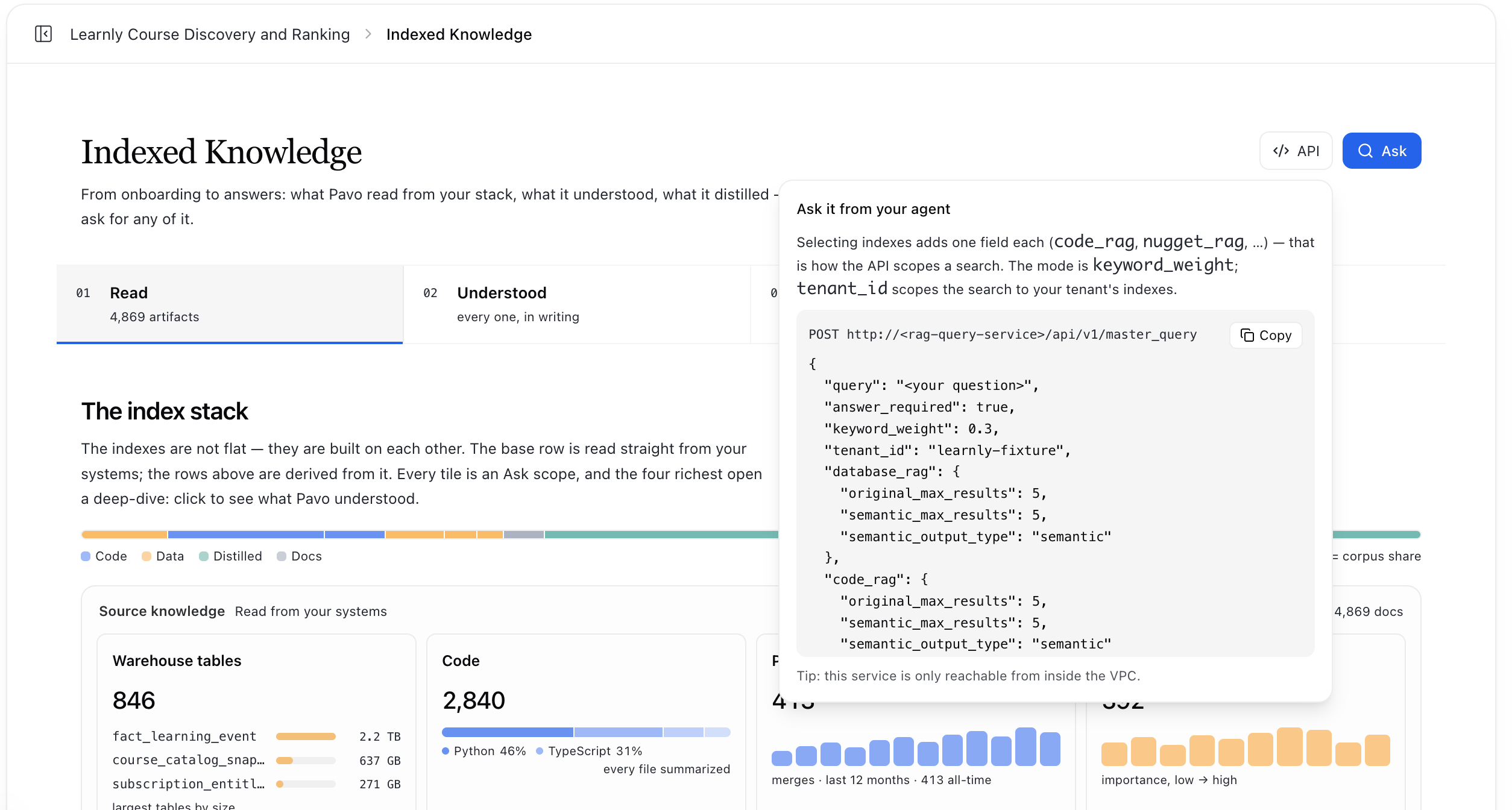
The facts Pavo extracts are exposed as a searchable index (a retrieval index over your knowledge). Two ways to use it:
* **In Pavo**: the book, the bench, and every agent draw on the index directly.
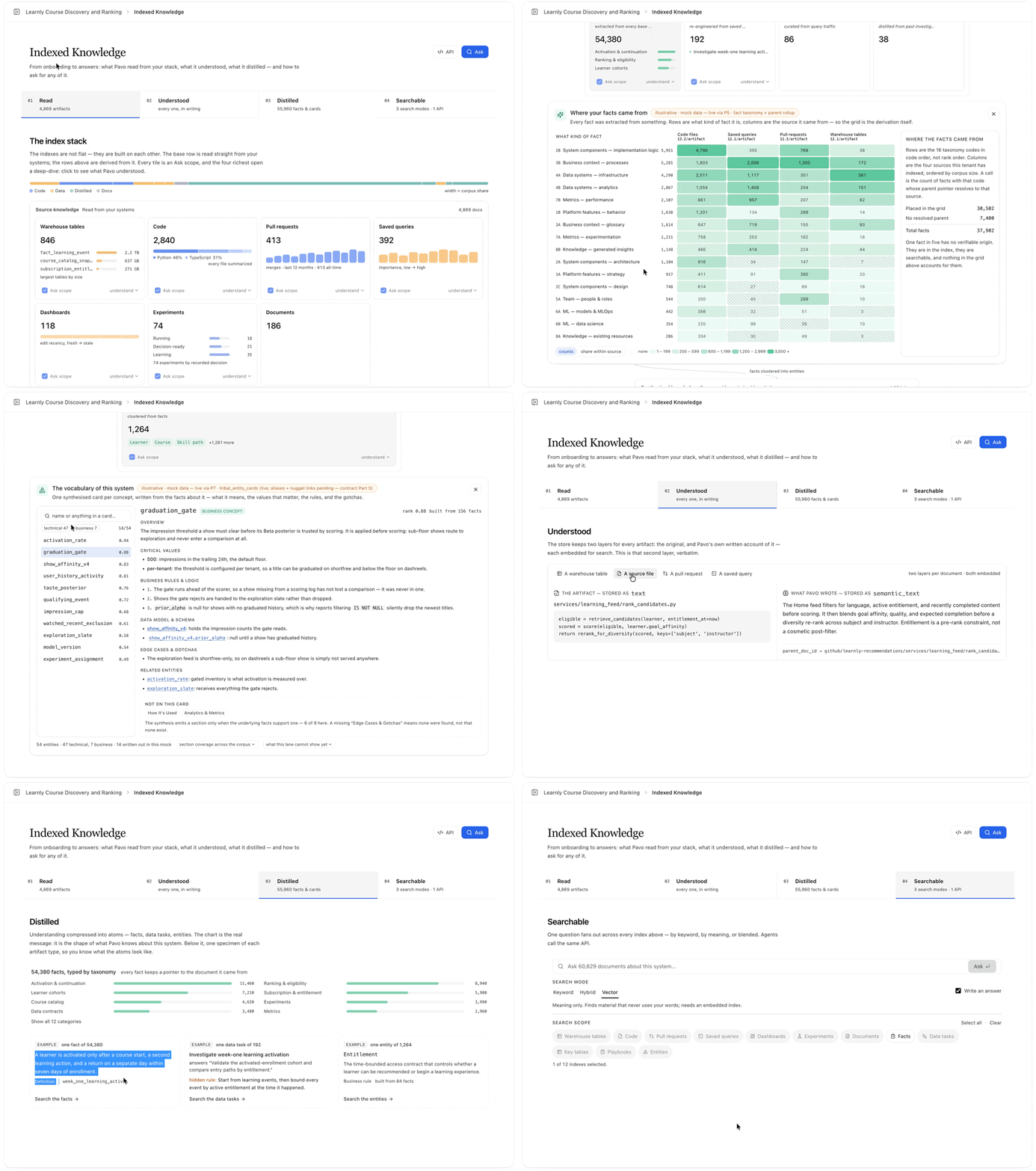 * **In your own tools**: query the same index from your coding agents (for example Cursor or Claude Code) so they answer with your system's real facts instead of guesses.
 ## Coverage and freshness
Indexing is not a one-time event. As your system changes and you do more work, the index needs to stay current and complete.
* **Re-scan** to pull in new sources, or to pick up findings from tasks you have run since the last pass.
* **Coverage** reflects what has been read versus what is connected, use it to spot a source that was connected but never fully ingested.
* What Pavo indexes is scoped to what you grant. A source you did not connect, or files you excluded, are simply absent, not silently guessed at.
If a connected source shows little or no extracted knowledge, treat it as a finding, not a given: it usually means a permission gap or an unreadable format upstream. See [Connectors](/connectors/overview).
## Next steps
How facts are distilled into a reviewable account of your system.
What each source contributes to the index.
## Coverage and freshness
Indexing is not a one-time event. As your system changes and you do more work, the index needs to stay current and complete.
* **Re-scan** to pull in new sources, or to pick up findings from tasks you have run since the last pass.
* **Coverage** reflects what has been read versus what is connected, use it to spot a source that was connected but never fully ingested.
* What Pavo indexes is scoped to what you grant. A source you did not connect, or files you excluded, are simply absent, not silently guessed at.
If a connected source shows little or no extracted knowledge, treat it as a finding, not a given: it usually means a permission gap or an unreadable format upstream. See [Connectors](/connectors/overview).
## Next steps
How facts are distilled into a reviewable account of your system.
What each source contributes to the index.