

What a result is
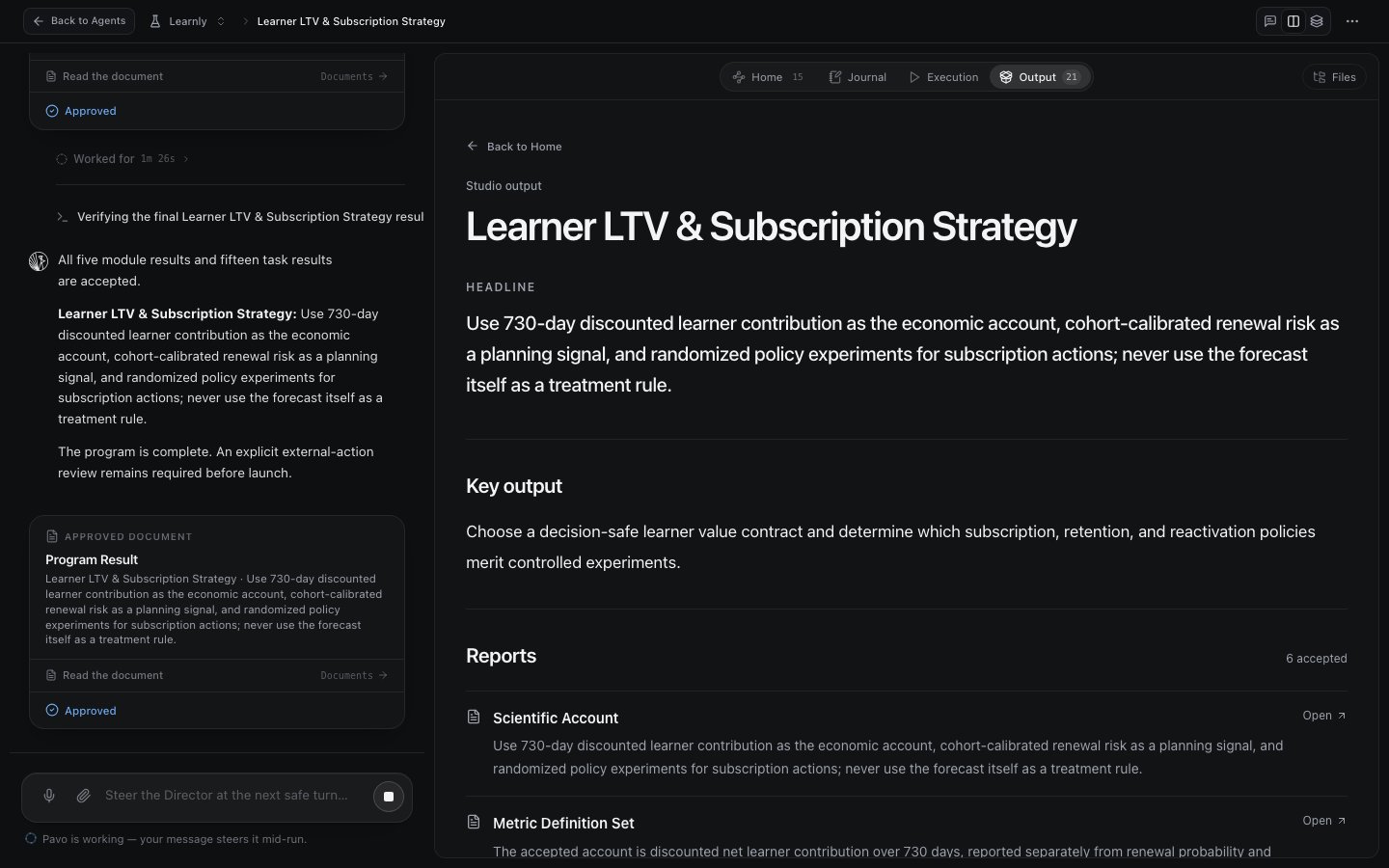
Not a claim: an account. When a Task Studio finishes, it returns a typed result, not free text. In the LTV program, one task returned aMetricDefinitionSet, another a MeasurementContract, another an ExperimentSpecification. The type tells you what kind of answer it is, and every result of a type carries the same fields, so you always know how to read it.
Each result declares four things:
That last field, the honest statement of what a result does not prove, is the one most tools skip and the one that matters most. A measurement of learner value is not permission to change a price. Agent Studio keeps the answer and its authority separate, on purpose.
Keep the three kinds of value apart
The sharpest discipline in the LTV program was a rule the plan set and every result kept: accounting value, predictive value, and causal value are different things, and one may never stand in for another.- Accounting: money already earned. A fact about the past.
- Predictive: a forecast of future behavior. Useful for planning, calibrated and bounded.
- Causal: evidence that an action changes an outcome. Only a controlled experiment earns this.
Where the work lives
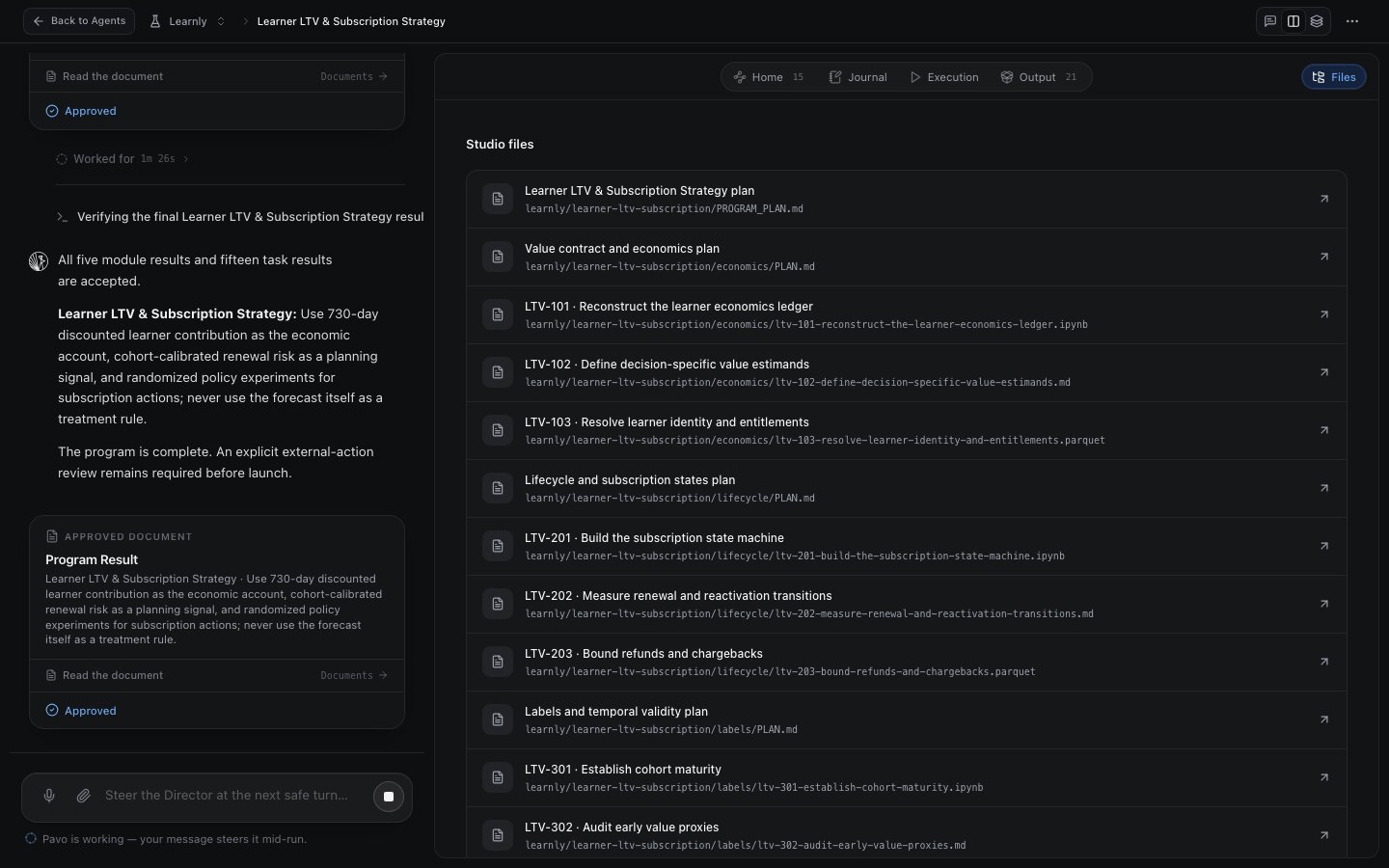
Everything a program produces stays in its studio, across a few views:
Because the files are real, they connect to how you already work: a notebook is a notebook, a dataset is a dataset, and they can be traced or exported.
How knowledge compounds
This is the payoff. Because the whole program lives in one studio, work multiplies instead of repeating:- Delta, not rerun. Add a new proxy or model and ask the Director to redo the analysis. It already knows the analyses, the findings, and the prior comparisons, so it hands back the same plots with one new row, not a from-scratch pass.
- Write-back to the hub. Any result worth keeping is pushed to the Knowledge Hub with its evidence chain, shared at the system level. The next program, and the next engineer, starts from it.
- Lower cost over time. Because consolidated knowledge is reused instead of rediscovered, later agent runs don’t redo settled work, which cuts token spend as much as it saves time.
This is the loop closing. Agent Studio spends the understanding System Knowledge built, and writes what it learns back to it. Each program leaves the system knowing more about itself than the last one found it.
Next steps
Best practices
Habits that turn program volume into compounding knowledge.
Knowledge hub
Where the findings you keep go to live.