

What indexing does
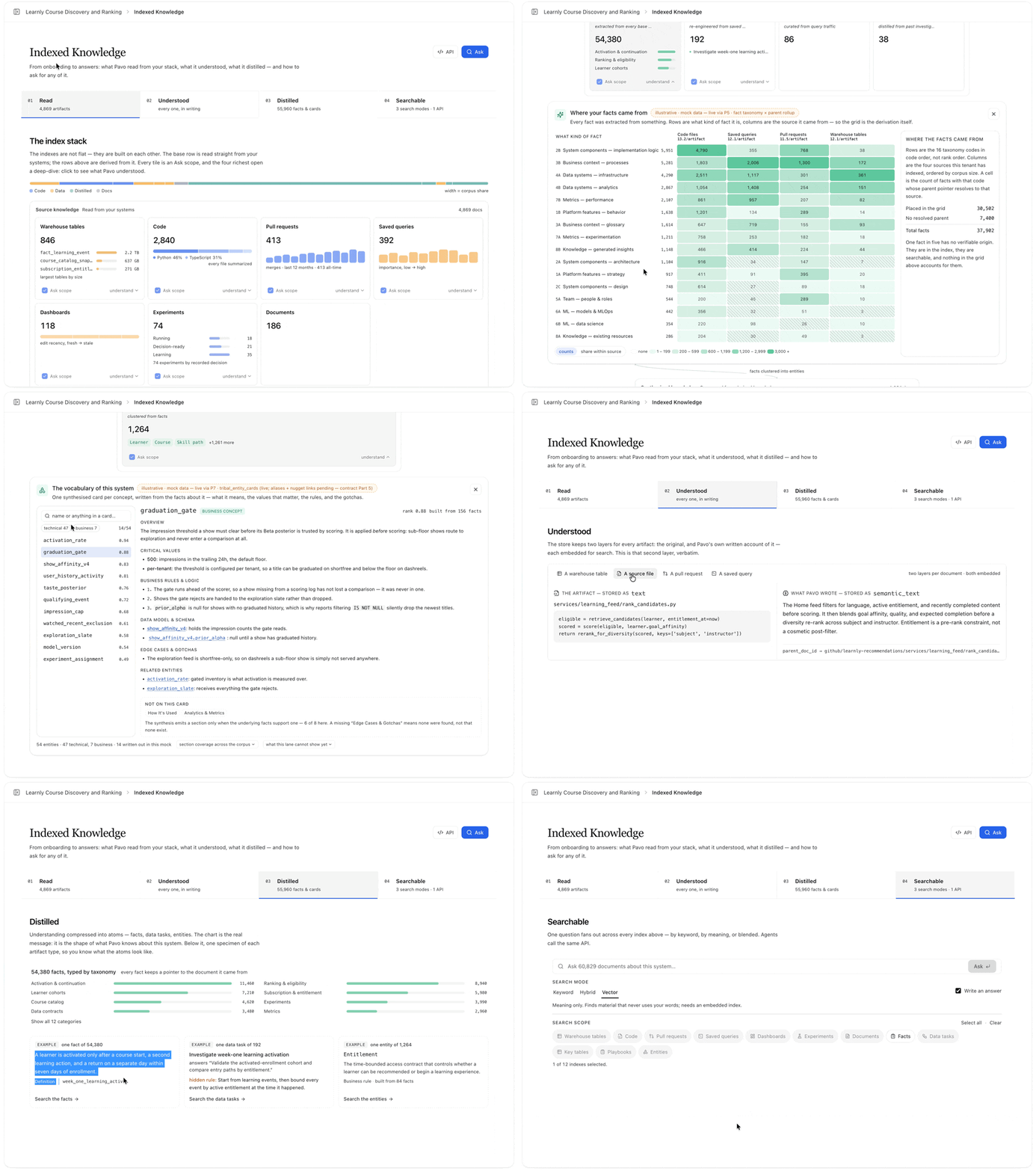
For each source you connect, Pavo works through every entity it contains and asks the same question: what did I just learn? A warehouse table yields its columns, owner, and a semantic description of what it holds. A code file yields how a component works. A past query yields how a metric is actually computed. Each answer is stored as one or more facts, with a citation back to where it came from. At scale this is a large amount of knowledge: a single connected system commonly produces tens of thousands of facts across its sources.Facts: the atomic unit
A fact is the smallest unit of knowledge Pavo stores. Every fact is typed, which is what lets the book and bench reason about the right things in the right places.Every fact is grounded
No fact stands on its own. Each links back, by citation, to the exact code, query, table, or record it was extracted from. This is what keeps the knowledge trustworthy: when an agent or a teammate relies on a fact, they can trace it to its source and see whether it still holds.Grounding is the difference between a knowledge base and a plausible summary. A fact you can trace, you can trust; a fact you cannot, you have to re-verify.
Using the index
The facts Pavo extracts are exposed as a searchable index (a retrieval index over your knowledge). Two ways to use it:- In Pavo: the book, the bench, and every agent draw on the index directly.
- In your own tools: query the same index from your coding agents (for example Cursor or Claude Code) so they answer with your system’s real facts instead of guesses.
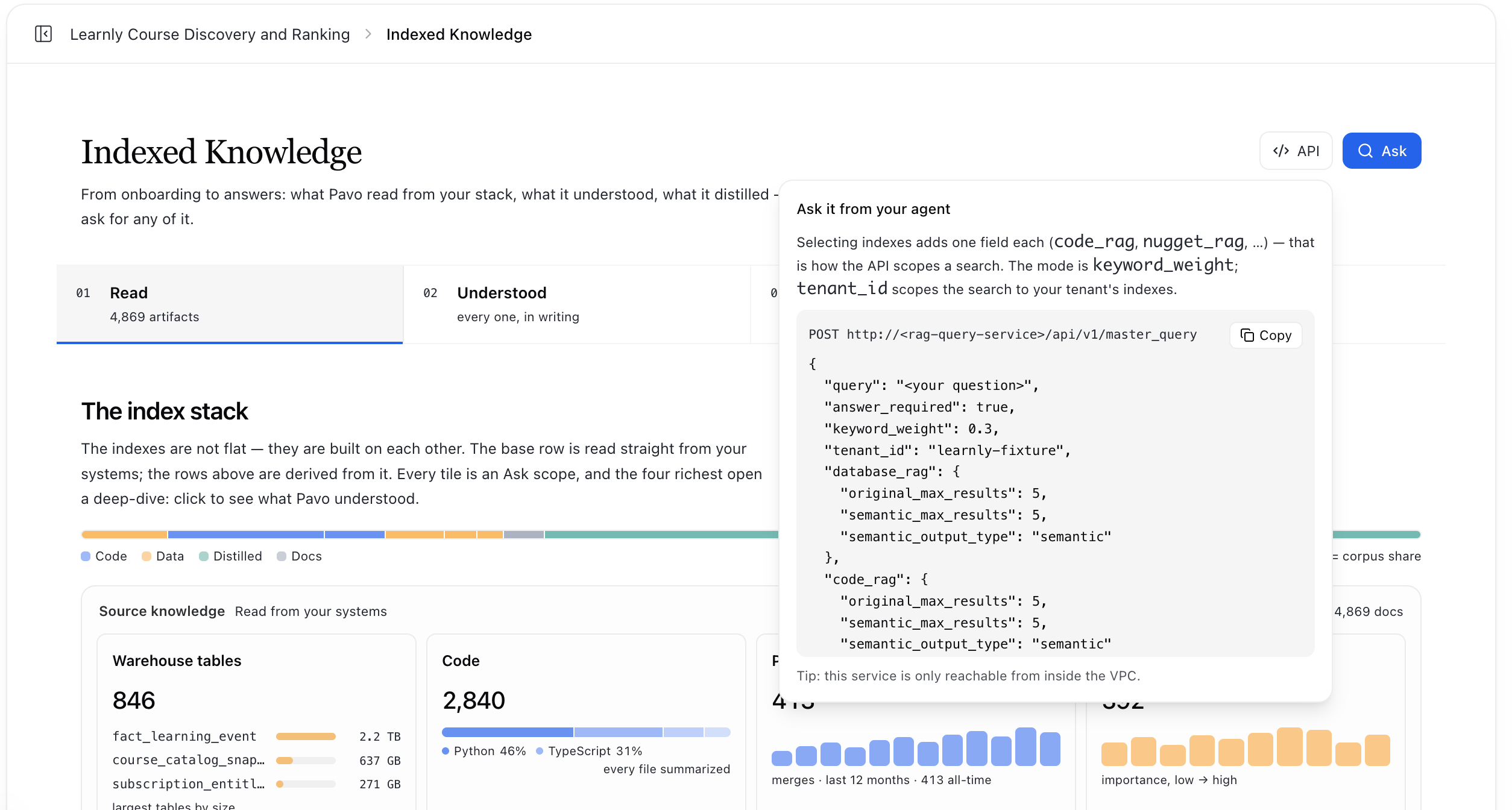
Coverage and freshness
Indexing is not a one-time event. As your system changes and you do more work, the index needs to stay current and complete.- Re-scan to pull in new sources, or to pick up findings from tasks you have run since the last pass.
- Coverage reflects what has been read versus what is connected, use it to spot a source that was connected but never fully ingested.
- What Pavo indexes is scoped to what you grant. A source you did not connect, or files you excluded, are simply absent, not silently guessed at.
If a connected source shows little or no extracted knowledge, treat it as a finding, not a given: it usually means a permission gap or an unreadable format upstream. See Connectors.
Next steps
Tribal book
How facts are distilled into a reviewable account of your system.
Connectors
What each source contributes to the index.