

Agent Studio is one of Pavo’s two modules. System Knowledge builds the understanding; Agent Studio uses it to find and prove improvements that move your metrics. Both run inside your own single-tenant environment. See Security.
Why one agent isn’t enough
Point a single agent at a multi-week research question and it drifts. It runs for hours, makes a hundred small choices you never saw, and hands back something confident and wrong. In our experience long-horizon single agents don’t hold up, not in Pavo’s early builds, and not in the general-purpose coding agents either. The fix isn’t a smarter agent. It’s structure:- A plan you approve before any work starts: the question, the modules, and the rules of evidence, agreed up front.
- Scoped agents: each one owns a small, checkable piece, not the whole problem.
- A director on top: one agent that delegates, watches the others, reconciles what they find, and catches problems on its own.
- Checkpoints everywhere: the work pauses for your judgment at every boundary that matters.
One program, one studio
Each question you bring gets its own studio. If you are stress-testing LTV proxies, that program has a studio; if you are deep-diving a finished A/B test, that’s a different studio. Everything the program produces, from the plan to every agent’s work to every plot and result, stays in that one studio, so the work compounds instead of scattering across tabs and notebooks.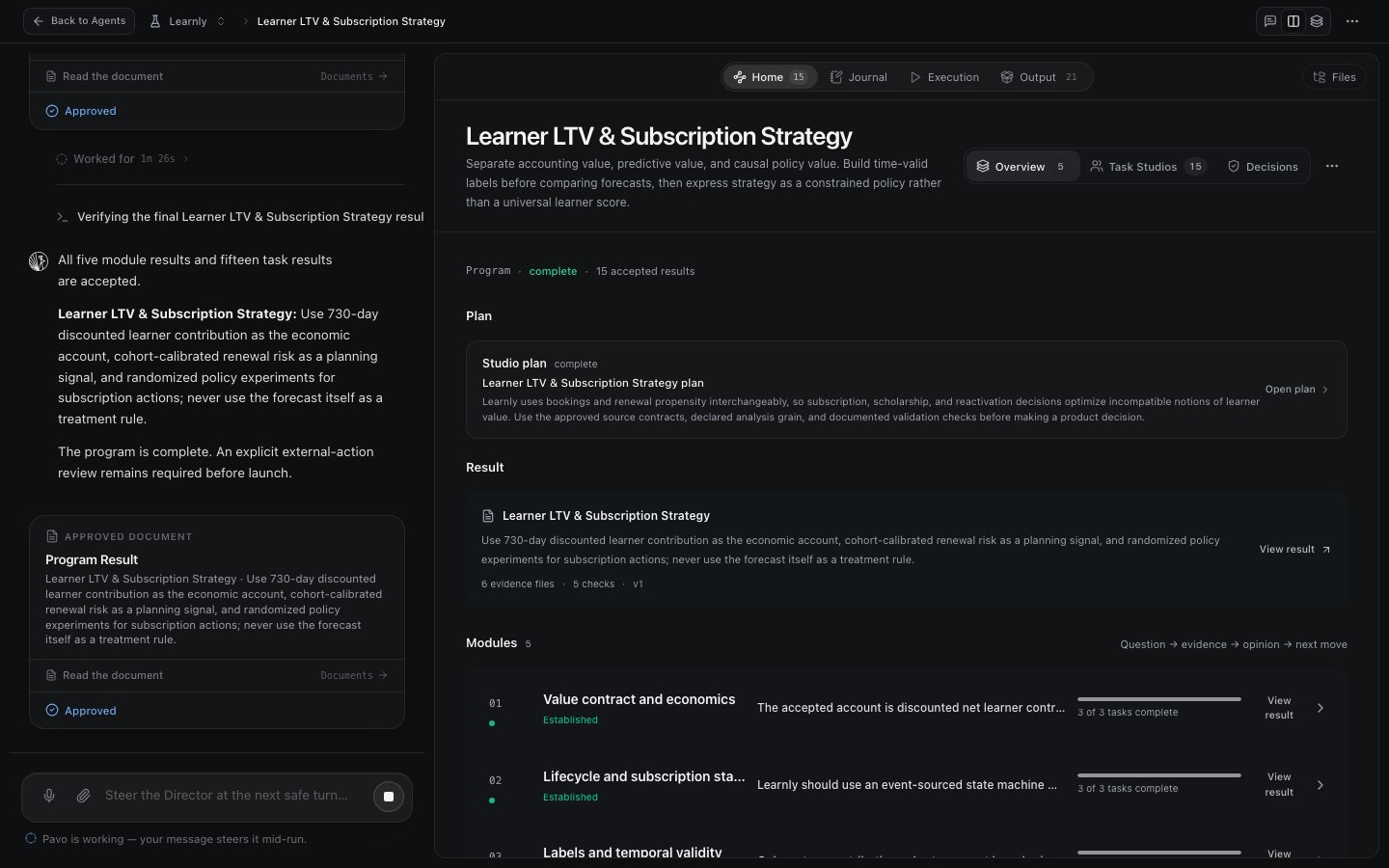
The building blocks
Agent Studio is built from a handful of primitives. They recur on every page, so learn them once.A Finding, the same primitive you met in System Knowledge, is what a result becomes when it is worth keeping. Findings are written back to the Knowledge Hub, so the next program starts smarter. That write-back is how the two modules form a loop.
How a program runs
1
Describe the program
Hand Pavo a real question and the decision it has to inform. Pavo reads your system knowledge to ground its plan.
2
Approve the Studio plan
Pavo returns a scientific frame and a breakdown into modules. You edit it, comment, and approve. Nothing runs until you do.
3
Let the fleet work
The Director delegates each module to scoped agents in their own Task Studios, and keeps them coordinated.
4
Decide at the checkpoints
Work pauses at each boundary for your judgment. You accept a result, redirect an agent, or add new work mid-run.
5
Keep what compounds
Proven results are written back to the Knowledge Hub, so the next program builds on this one instead of starting over.
Explore Agent Studio
Quickstart
Run your first program end to end.
Programs, plans & modules
How a program is framed, planned, and broken into modules.
Task Studios & the Director
How a fleet of agents does the work without going off the rails.
Evidence, results & outputs
The decision-safe contract that makes every answer trustworthy.